Is Tattoo Ink Safe? What Happens To Ink Inside Your Body
Tattoo ink is not automatically safe. It is a mix of pigments, liquids and additives. Some of its smallest particles leave the skin and get trapped in your lymph nodes, your body’s filters, where they stay for life. What slips through enters your bloodstream and travels past your heart, brain and liver. Researchers are studying links to lymphoma and allergic reactions, many inks contain unlisted ingredients or even bacteria, and U.S. law doesn’t require anyone to test them. How safe your tattoo is depends on the ink your artist chooses, so ask which ink they use and whether it’s been independently lab-tested.
Not All Tattoo Ink Is Made the Same. Is Yours?
Tattoo ink isn’t one standard product. Every brand has its own formula and its own supply chain, just like products on a grocery store shelf. Ingredients come in different grades of purity at different prices, and since U.S. law doesn’t require anyone to test the finished ink, some manufacturers cut corners to protect their profit. Few are ever held accountable.
So what does that mean for you, the person wearing it? Whatever was in that bottle is now part of your body. Researchers are still working out what that means long term, but here’s what science already knows: where the ink goes, what it does once it’s there, and why the bottle your artist reaches for matters more than most clients realize.
What Your Body Does With Tattoo Ink
Your body treats tattoo ink as a foreign invader from the first pass of the needle. Immune cells called macrophages are drawn to the wound and swallow the pigment, the same way they would swallow bacteria or debris.
Those cells don’t live forever. When one dies, it releases its pigment, and a fresh cell picks it up within weeks. Researchers in France watched this capture-and-release cycle in mice and concluded it is what keeps a tattoo looking the same for decades.
In plain terms, your immune system manages your tattoo for life. Whatever is in the ink gets handled, released and handled again, over and over.
Where Does Tattoo Ink Go? Your Lymph Nodes
Most of the pigment stays where your artist put it. The smallest particles don’t.
In 2017, scientists from Germany’s Federal Institute for Risk Assessment examined skin and lymph node tissue from tattooed donors. They found the same pigments, plus titanium dioxide and metals, in both places. Only the tiniest particles, hundreds of times thinner than a human hair, had made the trip.
Surgeons had noticed for years that the lymph nodes of tattooed people can turn the color of their tattoos. This study showed how it happens.
Your lymph nodes are filters for your immune system. They sit in your armpits, groin, neck and elsewhere, trapping what the body wants out of circulation. Ink that reaches them stays there.
Laser tattoo removal adds to this. It shatters pigment into smaller fragments, which may reach the lymph nodes faster (Dermatology Times).
What the Research Says About Long-Term Health
- Lymphoma. A 2024 Swedish study of nearly 5,600 people found that tattooed people had a 21% higher risk of lymphoma, a cancer of the lymphatic system. A 2025 Danish twin study also linked tattoos, especially larger ones, to higher rates of lymphoma and skin cancer.
- Immune response. In a 2025 study in mice, ink reached the lymph nodes within minutes, caused inflammation that lasted for months, and weakened the response to one type of vaccine.
- Allergies and breakdown. Red, yellow and orange inks are the colors most often tied to allergic reactions. Some colorants can also break down under long sun exposure or laser removal into chemicals linked to cancer in lab studies.
What the research does agree on: tattoo ink is not biologically inert, so what goes into it matters. That part is in your control.
You Pay for the Art, Not the Ink
Think about how you choose anything else that goes into your body. Food has a label you can read. Medicine comes with a leaflet. You hold it, compare it, and decide.
A tattoo works differently. You choose an artist by their portfolio, their reviews and their price. You pay for their skill and their time. The ink bottle never passes through your hands, so you never read its label, never compare brands, and most people never think to ask.
Yet the ink is the one part of the tattoo that stays with you after you walk out the door. Your artist makes that product choice for you, and you carry it for life.
Most artists aren’t cutting corners on purpose. Tattooing is still largely self-regulated, and many artists and suppliers simply aren’t informed about ink safety rules or risks. MoCRA brought tattoo ink under federal law in 2022, but in practice it changed the paperwork, not what’s in the bottle: no one has to test ink before it’s sold.
What’s Actually in the Bottle
Even when someone does read the label, the label isn’t always the whole story.
- Unlisted ingredients. When chemists at Binghamton University analyzed 54 inks from nine brands sold in the US, 45 contained pigments or additives that weren’t on the label. Some of the unlisted ingredients are known allergens.
- Bacteria in sealed bottles. In a 2024 FDA study, about 35% of sealed, unopened tattoo and permanent makeup inks had bacterial contamination, including some labeled sterile. Infectious disease experts say the count in anything injected into skin should be zero.
- Not just a US problem. The same Binghamton team tested ten inks sold in Europe as compliant with EU safety rules. Most had unlisted ingredients, and some contained pigments Europe has banned.
The takeaway: you can’t tell whether tattoo ink is safe from a claim on the bottle. Independent lab testing is the proof.
Want to know exactly what’s in the ink we use? At a free consultation, we’ll show you the bottle and its lab certificate.
Who Checks Tattoo Ink in the US?
Until recently, almost no one. In December 2022, the Modernization of Cosmetics Regulation Act (MoCRA) became the first major federal law to cover tattoo ink.
MoCRA was a real step forward. Ink manufacturers must now register their facilities and list their products with the FDA, and the FDA can now order recalls.
What it doesn’t do is require independent lab testing before an ink is sold. Mandatory manufacturing standards are still on hold too: the FDA moved that rule to its long-term list in 2025, with no date set.
So “FDA registered” means the FDA knows the company exists and what it sells. It doesn’t mean anyone tested what’s in the bottle or confirmed the tattoo ink is safe.
How to Ask Your Artist About Their Ink
You don’t need a chemistry degree to find out whether your tattoo ink is safe. Ask these before your session:
- Which brand of ink will you use on me? Any professional can answer this on the spot.
- May I check the bottle? Check the label on the bottle.
- Has it been tested by an independent lab? Many artists won’t know. Most assume anything sold to them was approved by someone. If they don’t know, look up the brand and check whether its test results are published.
- What does it mean if the manufacturer is registered with the FDA under MoCRA? It’s the legal minimum, not proof of safety.
- Have you used this ink on someone with my history? If you’ve reacted to a tattoo before, especially a red one, say so up front.
Once your tattoo heals, keep it out of strong sun, since UV light can break pigments down over time.
A professional won’t be offended by any of these questions. If an artist can’t tell you what’s going into your skin, that’s an answer too.
Conscious Above Profit: How Killer Silver Tattoo Handles It
At most shops, the chain of trust runs like this: you trust the artist, and the artist trusts an ink company neither of you has met. At Killer Silver Tattoo Studio, that chain is one name.
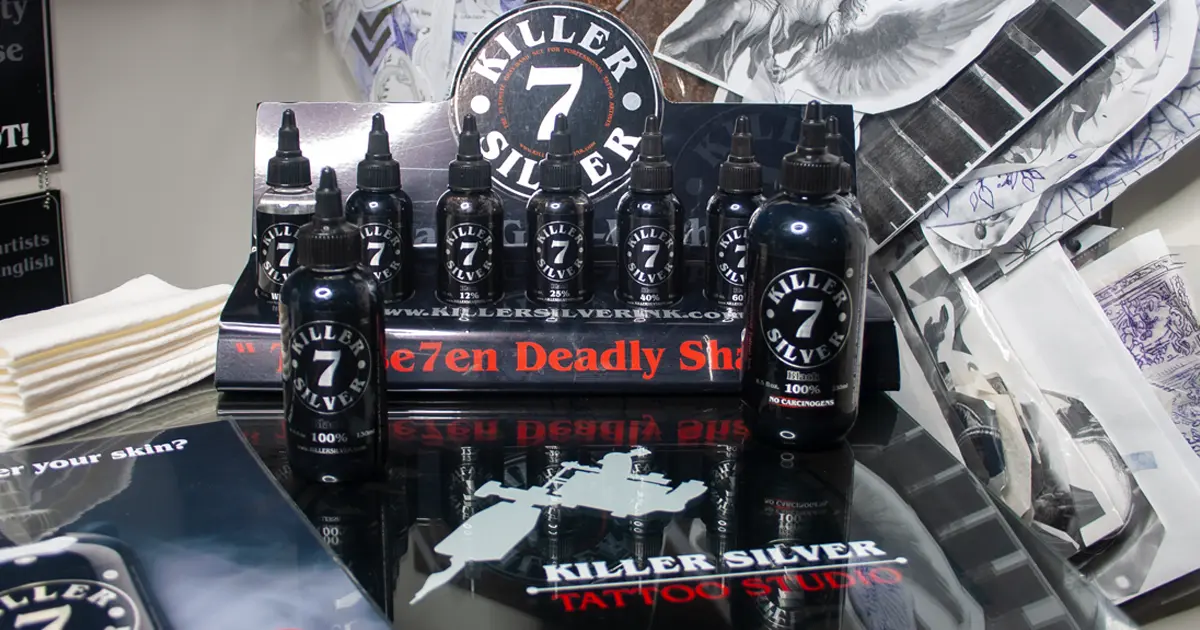
Caesar, the studio’s founder, also founded and still runs Killer Silver Ltd., a small-batch ink maker in Westchester County, NY. Its Se7en Deadly Shades gray-wash system is the ink behind our black and gray work.
- Independently tested in Germany. Caesar sent the formula to CTL, an accredited German laboratory. The first submission failed. He reformulated, and the new formula passed in 2013.
- Zero detected. The lab found none of the chemicals linked to cancer, heavy metals or restricted dyes it tested for (CTL Certificate Nos. 360083/1 and 360083/2).
- Years ahead of the rules. That testing came nine years before MoCRA existed, and before Europe made the same limits law in 2022.
- FDA registered. Killer Silver Ltd. is registered with the FDA under MoCRA.
We don’t ask you to take our word for it. See the lab results behind Killer Silver Ink, or book a free consultation and hold the bottle yourself.
Frequently Asked Questions
Is tattoo ink safe?
Not all tattoo inks are equally safe or honestly manufactured, and none of them are inert: some of their particles travel from the skin to the lymph nodes and stay for life. Choosing an artist who uses independently lab-tested ink is the most direct way to lower your risk.
Does tattoo ink go into your bloodstream?
Tattoo ink isn’t one substance. It’s a mix of pigment particles, a carrier liquid and additives, and each behaves differently under your skin. Most pigment stays in the dermis, where it forms your tattoo. The smallest particles, small enough to escape the dermis, are carried away by the blood and lymph fluids, and many of them collect in nearby lymph nodes. Research on how far they travel beyond that is still ongoing.
Can tattoo ink cause cancer?
That hasn’t been proven. Studies from Sweden (2024) and Denmark (2025) found higher rates of lymphoma in tattooed people, but they show an association, not cause and effect.
Is tattoo ink FDA approved?
No. Under the 2022 MoCRA law, tattoo ink manufacturers must register with the FDA and list their products, but no independent lab testing is required before an ink is sold.
What ink does Killer Silver Tattoo use?
Killer Silver Ink, made by Killer Silver Ltd. in Westchester County, which was founded and is still run by the studio’s founder, Caesar. The formula was independently tested and certified by CTL, an accredited German lab, in 2013, and the manufacturer is registered with the FDA under MoCRA.
Conclusion
Like anything else in life, the choice is yours, and so are the consequences. Not knowing what’s in the bottle won’t protect you from it. Research your ink the way you researched your artist, and make your safety part of the deal before the needle starts.
Still choosing your design? See 6 tattoos that symbolize freedom and what each one means.
Ask Us About the Ink
Wondering whether the tattoo ink in your next piece is safe? Bring your questions to a free consultation at Killer Silver Tattoo Studio, 34 Garth Rd in Scarsdale, NY. Consultations usually take 15 to 20 minutes, and you’ll see the ink before anything touches your skin.
“The art is what you see. The ink is what you live with.”